Wednesday, 17 September 2014

Predicting Election Results with Tarot


I teach a year-longtarot course and last Tuesday night, we had fun predicting the upcoming General Election in Aotearoa, New Zealand - as well as the Big Vote in Scotland.

Scotland is on a knife edge between “Yes” and “No”.

New Zealand too, has had an exciting campaign with shocking revelations of dirty politics smear campaigns and Edward Snowdon and Glenn Greenwald revealing  this week that our Prime Minister has been lying when he stated last year (and goes on stating now) that there was/is no mass surveillance of NZ citizens by NZ spooks.


Prediction is always a bit like reading the weather and those who live in Aotearoa know how challenging that is. However let’s bite the bullet and say that we think Scotland is going to vote “Yes”!

Aotearoa has a MMP government so figuring out the recipe for a potential coalition brew is a lot less straightforward to read. The images on the cards we drew are ambiguous in their interpretations. But with any oracle, hindsight is always a wonderful thing and offers a juicy learning curve.

There were 5 of us reading - 3 had strong political feelings, one had no knowledge of politics and one  was unable to vote as she was from a different country. We were using the Illuminati deck by Erick C. Dunne, The Oracleof Delphi by Janet D.H. Hinkel and the Waite-Smith deck. I have included all the images, as they are crucial when reading the tarot.


The Scottish Referendum.


We made a cross layout. The first card represented the Mood of the People. This sat above on the vertical line of the cross.

King Pentacles (Illuminati)


On the left on horizontal line we pulled 2 cards for the "Yes" vote.

The Empress (Delphi) and Ace of Fire (Gaia)


On the right of the cross bar we pulled 2 cards for the "No" vote

7 Wands (W/S) and Hierophant (W/S)


The last card sat underneath on the vertical line representing the Outcome

Princess of Wands (Illuminati)


The Illuminati deck’s King of Pentacles and Princess of Wands even look Scottish and vaguely Celtic.
The mood of the people seems confident in their sense of who they are, thinking about the practical aspects of the consequences of their decision, especially the economic and financial. But also aware of their own Scottish wealth such as oil and resourcefulness of character. This card reminded us also of the Kings and heroes of the past, when Scotland was an independent nation.


The "Yes" vote was symbolised by the Empress who in this deck is represented by an historical Queen – Zenobia, here shown as a prisoner of Rome. (Rome as a symbol of Empire!)
To quote the deck’s creator, Janet Hinkel “she is bold, intelligent authoritative and skilfully wielded political military and civic power …. Need we say more?
The Ace of Fire from the Gaia deck is a baby dragon peeking out of his/her shell. With fireworks in the sky behind.


The "No" vote has 7 wands in the Waite-Smith deck with a person on higher ground wielding a baton in the face of opposing batons coming at them. Feels like David Cameron and other Brits desperately attempting to turn the flood of popular opinion at the last moment. The traditional meaning of this card is potential success and standing one’s ground. But 7 is always an unpredictable number and Pythagoras likened its movements to a “flock of geese”.


The Hierophant is Westminster, the Establishment, the status quo, hierarchical authorities in their conservative robes preaching convention.


The last card pulled sits underneath and represents the outcome.The Princess of Wands is young and  idealistic, standing against a backdrop of snowy mountains, possibly indicating challenges to climb. She bears no resemblance to the "NO" vote cards but grasps her wand from the Ace of Fire – she is the baby dragon beginning a new cycle - the child of the Empress.

I believe this reading is telling us loud and clear that the Scottish “YES” vote will win. The Scots have fire in their belly – out of the initiating King of Pentacles emerges the fiery Wands suit. Sound out those jolly bagpipes!


 As for Aotearoa.


We used a circle. We all used our different decks and went round the circle pulling a card for each party. The first and last card were in the middle.


The first card pulled was placed in the middle and represented What the People Want.

The Empress from the Illuminati deck shows a splendid ruler seated in countryside holding wheat and a golden orb.  Aotearoa is one of the richer countries in natural wealth, reliant on an agricultural economy that sells dairy, meat and food products to the world. We used to think of ourselves as clean and green but lately our image has been tarnished by polluted waterways and toxic environments. Our lady’s gorgeous red robe looked like a carpet that could easily be used to sweep under all kinds of hidden agendas and abuses while giving us a gorgeous appearance. We have a thriving Green and organic movement, we love gardening and the great outdoors Mother Earth provides us. But many women in power are arrogant and materialistic including every woman in Team Key’s incumbent governing National party.

In general, women in Aotearoa have an independence and an autonomy that the rest of the world’s women might envy. However the image also suggests a stationary smugness, a conservative as well as conservationist approach.


All the rest of the cards pulled were placed around the circle until the last card which was popped beside the first card. We placed the different parties in order of their popularity in the polls.


2. The National party - 8 Swords from the Tarot of Delphi.

This is Andromeda shackled to a rock on the edge of a troubled sea. She is a sacrifice to appease angry gods. However although in the image, she is chained, hemmed in by sea and stone, buffeted by wind, the story goes on that she is rescued. So the National party is shown as restrained, exposed and subject to censure. All true in this election campaign, despite the Party’s colossal and overwhelming denial of all claims and evidence. Although a slavish weak 4th Estate has attempted to shore them up, maybe this card indicates the general public understands only too well the need to sacrifice this party? Or perhaps rescue will come from smaller parties?


3. The Labour Party – The Hermit from the Gaia deck.

This party has been unable to gain traction and is at a very low ebb. Father Time works slowly and meticulously but in this image is sitting still. There is gravity in his contemplative pose. The wise owl observes – lessons must be learned. Traditionally a card that means the need to understand the past, possibly it speaks of the people voting for this party who are still loyal to the Labour Party’s proud roots. But others have long memories of all the betrayals of those roots and earlier philosophies.


4. The Greens – The Chariot from the Waite-Smith deck.

So this party has the vehicle to take it where it wants to go. It is a Major Trump, so carries weight in the spread. I would say its confidence and comprehensive policies will convince the voting public it can succeed in governance (it has always found itself in opposition since its formation). This card brings success that is earned through effort. It also has a ring of victory.


5. New Zealand First – 6 Pentacles from the Waite- Smith deck.

Despite its Minor Arcana card, this party looks to be in the “Kingmaker”  position as far as forming a coalition government. Its leader Winston Peters is shown doling out favours with two different competing factions on either side. Confusingly for the predictor, on his righthand the person receiving his beneficence is dressed in orange (Labour Party is ‘left’ and red) and the person on his leftside missing out  is dressed in blue (National Party is right and blue). Winston is known for his sleight of hand and ambivalent giving and taking away.


6. The Conservatives – 10 Wands from the Illuminati deck


The man in Blue (Right party) is heaving a weight of sticks but struggling to get over the line. It seems clearly to be saying this Party won’t quite make the numbers of 5% needed to get into parliament (the path is leading to the castle).
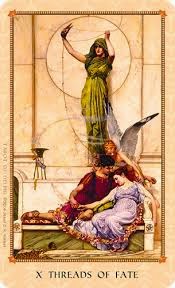


7. The Internet-Mana Party - The Threads of Fate from the Delphi deck.

This is the Wheel of Fortune in the older decks. In this picture we have the Moirai - the Fates – spinning the threads of destiny, apportioning life and death. This card symbolises unexpected fortunes and uncontrollable events. Kim Dotcom, creator and funder of the Internet party is a larger than life personality who has dominated the headlines in this election and has been instrumental in bringing to our attention Greenwald and Snowden’s revelations about mass surveillance on NZ citizenry. This has been world-wide news which has yet to play out for this government in all its ramifications. What goes around comes around on the great wheel of fate.


8. The Maori Party – The Empress from the Gaia deck

So here we have a card resonating with the mood of the people in card number 1. The Maori party represent many of the indigenous people of Aotearoa. I would think this means that the Maori Party will be a significant player in the outcomes of the election. The barefoot woman is wearing a red dress – does this mean the party will become more radical in their actions? She appears pregnant, fruitful and empowered. This does not suggest a party that is disappearing.


9. The United Party - Knight Swords from the Waite-Smith deck

Is the leader – really a one-man band – Peter Dunne going to be the knight in shiny armour rushing to the National Party’s distressed side? He’s full of himself and a man with a mission.


10. The Act Party – The Fool from the Waite-Smith deck

Need I say anything at all?! Hilarious really. The party is a joke and the leader a racist. So far down in the polls it hardly rates. Obviously the NZ public think its foolish. Still one of the meanings of this card is “out of left field” – oops that’s left field, not right field.


11. The Outcome – sits in the middle beside Card number 1 - what the people want.

6 Swords from the Illuminati deck

The woman in the boat appears to be The Empress (the people) in our red dress. A small child in green and red sitting elevated on a box - looks beseechingly up at the man rowing dressed in red. Could this be a coalition of Labour and Green? However if it’s National rowing us forward, is the small child (party) NZ First?

There are swords (adversity)  blocking our view of the future and the green land ahead. The woman passenger appears distressed but unresisting. Certainly many of our electorate appear to be submissive consumers on whatever the authorities feed us.

There is an ominous black cloud above the boat – the ship of state – but it sails forward convincingly. There are 2 patches of blue and red on the bottom of the boat representing the 2 major parties.


I really can’t call on this one, but will have fun de-briefing in hindsight.

I welcome your input and insights!

Friday, 12 September 2014

The Seven Deadly Sins. Part 2


Part 2
Avarice, cupidity or covetousness,like lust and gluttony, is a sin of excess. However, this kind of greed is applied to an excessive and rapacious desire and pursuit of material possessions. Greed is an inordinate desire to acquire or possess more than one needs, especially with respect to material wealth. Witness our national credit card debt and the pursuits of retail therapy, indulgent consumerism and commodity fetishes that fill our leisure times.
Avarice wants to get its "fair share"- and more.
Avarice is alive and doing very well in NZ. The wealth split is much worse here than most people realise.
The richest 20% of us owns 70% of NZ wealth. Only 10% of people own over half of this wealth. A third of that belongs to the wealthiest 1%. 
The rich are really greedy.

A political solution would be of course a re-distribution of the world’s wealth fairly. Sadly, I suspect avarice will continue to thrive in the current cultural climate where Avarice is a way of life, totally entrenched in all our systems of thought and practice.


Like greed and lust, Envy  is characterized by an insatiable desire. Envy is similar to jealousy - they both feel discontent towards someone. It might be the other’s status, abilities or character traits; whatever another person has, Envy wants it or more of it. The difference between being jealous and envious is that envy covets the object of desire; it eats its heart out.
Envy resents the good others receive or even might receive. Misplaced envy greets any attempts in rectifying social injustice (such as raising welfare benefits to solo parents for example) with screams of dissent. (undeserving lazy solo mothers don’t ‘work!”).
Dante defined envy as "a desire to deprive other men of theirs". In his book Purgatory, the punishment for the envious is to have their eyes sewn shut with wire because they have gained sinful pleasure from seeing others brought low.

Aquinas described envy as "sorrow for another's good.” The modern media urges its consumers onto ever greater heights of envy or schadenfreude (which means gratification or triumph in seeing another fail or suffer misfortune.) Gloating has a similar meaning, but envy implies malice within the delight.
Love and its sisters Compassion and Empathy might help ease the pangs of envy.


Wrath  - rage – manifests as uncontrolled feelings of hatred and anger. Self-destructiveness, violence, and hate drive wrath and can provoke feuds that can go on for centuries. Wrath may persist long after the person who did another a grievous wrong is dead. Revenge and honour killings are horrible examples.
Dante described vengeance as "love of justice perverted to revenge and spite". The endless, deadly, dreary conflicts in the Middle East and other places throughout the world are horrifying and tragic examples of Wrath at its very worst.

Anger is often our first reaction to the problems of others, accompanied by impatience with their faults.
Interestingly, Wrath is the only sin not necessarily associated with selfishness or self-interest. Someone can of course be wrathful for selfish reasons such as jealousy (that is closely related to Envy.)
But anger can in fact be healthily expressed and its expression is often necessary for healing and well –being. Outrage seems to me a rage accompanied with feelings of helplessness that is often part of deep grief.
In its original form, the sin of wrath also encompassed anger pointed internally as well as externally. Thus suicide was deemed as the ultimate expression of hatred directed inwardly - a final rejection of God's gifts.
Self-destructive behaviours such as drug abuse or suicide are tragic manifestations of rage turned inward. They cause great grief and even rage when they affect others – as they always do.
 I don’t think suicide is a sin and I deplore the older Christian viewpoint which pointed to a punishing god with no compassion for the misery of despair. Despair is a ghastly endpoint, but going there is often a journey the most sensitive and intelligent people make.
Kindness, communication and long-term patience do help wrath turn the other cheek. Counting to ten and walking away are conventional wisdoms that work.
Crimes of Passion are not well-served by an adversarial justice system. Restorative Justice with an inquisitorial system and Courts of Truth and Reconciliation with processes committed to restitution and negotiation, seem more sensible ways of addressing crimes of rage. But how we solve the problems that millennia of feuding, land theft and murder of innocents, (eg in the Middle East) is beyond me. All I know is that the means never justify the end. War can only ever be resolved through peace. Escalation of violence is the worst manifestation of Wrath.

Lust or lechery a sin of excess, characterised by intense desire, whether for money, food, fame, power or sex. Lack of self-control is evident and in Dante’s Inferno the unforgiven souls racked with lust are driven by restless hurricane-like winds.
The movie Wolf of Wall Street is a modern riff on the endless versions of Lust available to us.
 Lust’s drive for pleasure is out of proportion to its worth. The pursuit of happiness – as entitlement - seems to be a given in the modern West (in fact written into the American Constitution). But happiness under Capitalism has been consistently defined by a lust for material pleasures.

 “….Because I’m worth it” is the raison d’etre driving so much of our consumption and debt. Never mind if it’s at the expense- for example- of the 3rd World peoples (child slave labour that make our clothes and shoes), or dairy products that wreck environmental and water degradation.  Pornography, sex trafficking, manufacturing of such products as S.U.V.s and drugs) - all thrive on a small elite’s lust for power and the passive co-operation of the masses who consume  the ‘happiness’ commodities dished up to them.
In our daily lives the constant craving for the next flavour in vogue, the latest trendy style, the fashioning of self on the hottest – or coolest – celebrity of the moment. Craving and craven are words that seem to express the obsessive celebrity culture we witness daily in our media. The restless yearning after external stimuli to gorge that gaping internal void is horrifying to be part of.

Self control and self-respect are virtues to foster when grappling with Lust.

Gluttony - in Latin it means to gulp down or swallow. Like Lust and Avarice it’s all about excess; over-indulgence and over-consumption of anything and everything to the point of waste. Gluttony is the selfishness that places our own interests above the interests or well-being of others.
If we take a more narrow view of the concept, it will mean gluttony only in relation to food. For example an excessive desire for food that causes food to be withheld from the needy. 
Advertising and serial cooking shows on our TV screens encourage the obsessive anticipation of meals, or the constant eating of delicacies’ and costly foods. Supermarkets are adept at catering to our lusts. They import foods from faraway places for the domestic market at the expense of our carbon footprints. They sell strawberries from California in the middle of winter. They throw out waste food when the poor go hungry and their cynical displays of lollies at eye-shelf level encourage children to lust after unhealthy food that will make them sicker quicker.


The unlimited sale of takeaway fast foods and the huge - and huger - portions served are examples of societal inability to prevent runaway gluttony. Unregulated promotion and usage of sugar and carbohydrates are actively causing modern plagues of explosive obesity and diabetes.

Binge drinking is a form of gluttony (gulping down). Our young people are practically weaned on this way of socialising with their peers, with all the resulting self-disgust, chaos and alcoholism that follows.


Promoting the quality of Temperance might help us to begin to accept the natural limits of pleasures, not just with our food but in all over-consumption. Beginning to preserve a natural balance; not only in the pleasure we take in food but also in entertainment and even in the company of others.


Sloth is sometimes but not always defined as physical laziness. The apathy of spiritual laziness is emphasized in the Christian faith. Sloth is a failure to do things that one should do. By this definition, evil exists when good men fail to act. Indifference and passivity become active refusal to help others in times of need or to be responsible citizens. Sloth is also the failure to utilize one's talents and gifts.
When our mainstream Pakeha value system rejects and locks out Maori and Polynesian language and culture, this is the sloth of failure to support dispossessed peoples. If we don’t make active efforts to acknowledge and integrate, unemployment, prison and alienation result for many - who then suffer from the malaise and apathy of those who are not using their talents.


Thomas Aquinas included the idea of Acedia, describing this as an “uneasiness of the mind.” It is a Latin word that means the neglect to take care of something that one should do. Melancholy is the emotion that leads to acedia which manifests as apathy or listlessness, depression without joy. In its ultimate form acedia was despair that leads to suicide. Again the Christian viewpoint described the black dog of despair, as a wilful refusal to enjoy the goodness of God and the world God created. I think our modern idea of despair as an illness is a better one than this. Yet it’s not perfect either. Our modern medicalization of sorrow or melancholia can also lead to lethargy and ennui.

A counterbalance must be to find meaning and a sense of belonging in our lives. Going back to our roots and discovering a culture or a past that may have been stolen from us can re-vitalise us. Active healing therapies can restore a belief in the damaged self and encourage us to be part of a community. Opening ourselves to love that connects us to people round us can restore a feeling that we can make a difference. Creative expression supports us to find the necessary enthusiasm that will galvanise ourselves out of the deep sleep of the complacency that turns a blind eye.


The seven sins are really deadly. They are killing us and Mother Earth. The interesting thing about all the sins except for Wrath, is that they describe what we do in relational terms. Humans are social animals and don’t exist in isolation. We operate within communities and habitats. Our personal lust, pride, or sloth impacts on everyone else and on the natural world. The personal is political so it is imperative we build a new morality to counteract the big lies corporate capitalism has sold us. The only moves that will really checkmate the seven deadly sins are to instigate economic sustainability for our beautiful blue planet and ensure social welfare for the community of all the creatures that live on her.

Monday, 8 September 2014

The Seven Deadly Sins


Part One.


Lucifer

I’ve always been fascinated with the dark side of human nature. I’ve also long observed the political dynamics of whatever group I’m in, whether family, friends, work, community and nation. Politics means to me the study of power – who has it, how they work it and what happens to those who become disempowered.
The adage goes “Power corrupts…” and that seems very apt this Electoral Campaign as the trickle-down effect of the stench from Dirty Politics invades us. Watching my own reactions of disgust and outrage to the Dirty Politics saga initiated this blog post. It’s my attempt to understand my own reactions as much as the motivations of the politicians concerned.
As usual I turned to the past to get a grip on the present.

Our cultural traditions in the West have long instructed us in how to be a good person, living in a moral society. The Greeks gave us the idea of the four cardinal virtues and taught us the ideals of democracy. Yet bad behaviour such as theft or murder has consistently thrived then and now. Religions have set moral and ethical guidelines, but their institutions and followers have been pretty useless at practicing them.
The seven deadly sins are an old Christian list of qualities that describe seven most important ways of humans being bad. They are Pride, Avarice, Envy, Wrath, Lust, Gluttony and Sloth. I figure their descriptions capture beautifully most everything nasty and horrible that humans are capable of.
When I started thinking about this list I realised that individually and personally we are all familiar with one - or several - of the seven sins. Generally most people – religious or otherwise - manage subduing them and run amok only occasionally. But our contemporary western society as a whole seems to amplify and exemplify them all at once.

The history of the West has been characterised by elites in power using force (the State) backed up with ideology from the pulpit (the Church). This unholy combo has excelled in teaching people to live under such lovelies as misogyny, state-sanctioned murder (war) and hierarchies that must never be questioned.
Nearly always it was/is men who have been in charge of authoritarian political and religious systems. Female experience and voices have not been acknowledged and indeed, actively oppressed.
Today the Church and State partnership has devolved into a more secular western capitalist economy run by global corporates. Democracy limps along as it struggles to appease the Gods of Mammon. The governing ideology is that of unlimited growth and is practiced at the expense of our planetary environment. Consumers are encouraged into an almost obligatory permissiveness that carries an injunction to gratify more and more perverse desires.
Worship of Mammon
Despite the widespread (but not complete) secularisation of New Zealand and a Kiwi suspicion that God is dead, other parts of the world seem hell-bent on proving that religion is vigorously thriving. God is apparently alive and doing awfully well working through the big three –monotheistic and often competing - religions (Jews, Christians and Muslims). However He doesn’t seem capable of slowing down the seven deadly sins running amuck destroying our world.  Wherever we look – here or there – morality seems strangely divorced from the practice of religion. So I am dispensing with the myth that we need religious stories to lay a moral compass for humans.
Still, those people from our past did know a thing or two about the way people tick. Being good is a challenge and stories are helpful navigational tools. I’m using the Christian list of the seven sins as a template or framework, but will explore them in my own pagan way.

The seven sins were named early in Christianity’s history - the Church was great at defining human failings - and then committing the very sins they outlined. The list of sins was apparently first compiled in the Dark Ages by Pope Gregory the Great who reigned as Pope from 590 till his death in 604, when he was promptly created Saint (despite his rather awful evil-doing as a mere mortal. )


Before I bandy around the words sin and evil anymore, it’s important to clarify them. Words we use mostly originate from a variety of ancient roots. The word sin is a Christian idea, for it assumes there is a god with a capital G. If a Christian commits a sin, they transgress a religious or moral law, or are deliberately disobedient to the will of their God (who is good but loves to punish).
In other words they do evil. Evil -like sin – is a religious word, used to denote profound immorality and sometimes even described as a supernatural force that fights eternally against the moral white knight of Good. The Devil - a most marvellous myth - is the personification and apex of sin. He continually struggles against his original master and moral absolute the good God. (a very masculine conversation going on here.)
In normal everyday conversation, we non-Christians would use the word evil to mean something heinous, contemptible, really, really bad.
So while eschewing a Christian or otherwise religious viewpoint, I’m utilising Christian-based words – which is what most of us do anyway in this contemporary, secular, Kiwi culture.


Pride
In most lists, Pride – or in Greek Hubris – is considered the original and most serious of all the sins and source of all the others.

Essentially it is a belief that one is better than everyone else. It will manifest as arrogance, disdain, scorn, contempt, snobbishness and sneering down one’s nose at others. It indicates a loss of contact from reality, a failing to acknowledge the accomplishments of others, and an overestimation of ones’ own competence, often exhibited by those in power. 

This is particularly noticeable today in the ruling class of politicians, the best example being Team Key in conjunction with bloggers and a tame media. 

Ex-Cabinet Minister Judith Collins has Pride down to a fine art. Hopefully her fall will be as spectacular as her hubris.

The arms trade, especially the nuclear armaments industry or political advocates of dropping a nuclear bomb on another country have an extreme case of mega-pride.

Dante's definition was "love of self, perverted to hatred and contempt for one's neighbour". We seem to despise anyone who is “other”, whether it immigrants, foreigners, anyone in fact who doesn’t belong to our clan.  As soon as we compartmentalise “us” from them” and conjure up different ways of treating them from us – that contempt marks our pride. All the oppressive and/or institutionalised behaviours that show an inability to treat all people fairly - eg racism or ageism - fit here pretty snugly.

Pride is also defined as an excessive admiration of the personal self. Society’s values certainly encourage an obsessive focus on one’s body or decoration and clothing of the body. Vainglory or Vanity is a form of Pride. This can mean futile boasting – certain TV or radio presenters spring to mind. But this kind of Pride has strong narcissistic undertones. Western capitalism has bequeathed a ruling ethos of narcissism - “it’s all about me”.  This is particularly prevalent in celebrity worship and the belief we are all due our 15 minutes of fame.

In Greek tragedy Pride could mean excessive pride or defiance of the gods, but usually referred to crimes committed by mortals against mortals. It was not generally thought of as a religious matter. It would also refer to actions that shamed and humiliated the victim for the pleasure and gratification of the abuser. Aristotle called it ‘shaming the victim”. Often there were strong sexual connotations.
Today we might call it assault and battery, or sexual crimes such as rape, or the theft of public or sacred property. Sound familiar? 200 domestic violence events occur every day in N.Z – that’s one every seven minutes. This is mass pride inflicted by one gender working itself out on disempowered women and children. Furthermore our adversarial courtrooms still put rape or domestic violence victims through a public shaming. 


The antidote for the sin of Pride would be to consciously cultivate the qualities of Humility, Compassion and Tolerance. It wouldn’t go amiss either if we tried practicing a lot more celebration of inclusion and cultural diversity. But above all we must work as a community to abolish the idea that one gender –men - are entitled to disrespect, shame and abuse women.
The sin of Pride is different than the way we often use the word pride. Taking pride in one’s work or achievements is often a way of expressing healthy self –respect. Cultivating this kind of pride is important. Women especially often suffer from lack of pride. Because society doesn’t value women’s work such as unpaid child-rearing and housework, the active building up of our low self-esteem through pride becomes an essential path to societal health.